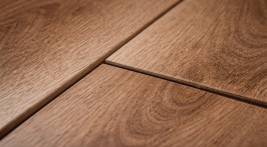
Uneven Floor and Panels – How to Level It
A well-chosen insulating underlay for panels can handle minor unevenness. However, larger irregularities exceeding 3 mm require leveling compounds. You can assess floor unevenness not only with a spirit level but also by placing a straight board on the surface. Gaps visible when moving it indicate irregularities. Remember, the maximum underlay thickness is 3 mm.
Ways to Level the Floor
The most popular and relatively simple way to level a floor is with self-leveling compounds – based on anhydrite or cement. They’re affordable, easy to use, and suitable for underfloor heating. Downsides include a long drying time and moisture. Faster methods include using epoxy or polyurethane resin or opting for dry screed.
Why is leveling so important? Installing panels on unevenness greater than 3 mm may soon cause deformation and cracking. Beyond damage, you’ll also experience reduced comfort when using the floor.
Uneven Wooden Floor
Irregularities are especially relevant with wooden floors. If you plan to lay new panels over old boards, you’ll need to address any unevenness or damage. For minor issues, sanding and filling gaps may suffice, followed by applying a good underlay. For significant height differences, dry screed is recommended. As a last resort, after separating the wood with foil, a wet leveling compound such as anhydrite may be used.
Which Underlay for Floor Panels?
Once the floor is leveled or if irregularities do not exceed 3 mm, it’s time to choose the underlay. Its main task is to extend the lifespan of the panels, but a good-quality underlay also reduces impact noise, increases compression and deformation resistance, protects against moisture, and limits heat loss with hydronic underfloor heating.
Laminate flooring is a floating floor, which means it’s not fixed permanently to the subfloor. A certified underlay significantly extends panel durability and improves everyday comfort.
Types of Underlay
Underlays can be natural – made from wood or wood-based materials – or synthetic, including foams and plastic-based products. Natural types include cork, eco boards, corrugated texture, and corrugated paper. Synthetic ones include polyethylene (PE), polystyrene (XPS), and quartz mats. Certified underlays with clearly described parameters are recommended, such as polyethylene (PE) or natural quartz mats with 2 mm thickness.
Which Underlay for an Uneven Floor?
Not all underlays available on the market can compensate for unevenness. When choosing an underlay for panels on an uneven floor, you should look for the best-performing option. As mentioned earlier, this applies to unevenness up to 3 mm per 1–2 linear meters. A good choice is a high-density polyethylene underlay integrated with an aluminized vapor barrier, which not only compensates for unevenness but also offers excellent moisture protection. It is designed especially for floating installation of laminate floors with increased water resistance up to 24h.
Which Underlay for a Wooden Floor?
There is no one-size-fits-all answer to the best underlay for panels on a wooden floor. It depends on several factors – the condition of the wooden floor, its dryness and stability, and your expectations from the underlay.
For wooden floors, high-density underlays (around 780 kg/m³) are suitable. We recommend a 2 mm thick underlay made from a high-density mineral-polyurethane compound that is 93% natural. This underlay ensures optimal support and compatibility with wooden substrates.