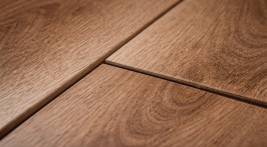
Expansion gap – what it is and how it affects panels
First, a brief explanation of what an expansion gap (dilatation) is. After installation, wood-based floor panels “expand and contract,” a natural and typical phenomenon called the “floor’s movement.” This occurs because laminate panels are mostly made of wood, and their dimensions react to changes in temperature and humidity in the room. The expansion gap allows panels to move freely, so panels should always be installed as a floating floor – they must not be fixed permanently to the substrate.
The expansion gap is the free space left between the panels and walls or other fixed structural elements such as stairs, door frames, pipes, radiators, or balcony window elements. It allows the panels to change size (move or “float”) without risking damage. Usually, the expansion gap should be at least 10 mm.
What expansion gap for panels?
The required expansion gap depends on the panel type, room size, humidity level, and expected temperature changes—for example, from underfloor heating in winter. As a rule of thumb, the minimum distance between the last panel edge and the wall or threshold should be at least 10 mm.
For detailed information on the exact expansion gap, consult the installation instructions included with your flooring or the manufacturer's website. For Weninger laminate panels, the guideline is a minimum 10 mm gap. Depending on the room’s specifics and the potential panel expansion, you might consider a larger gap, which must be covered by the baseboard.
Remember that leaving an expansion gap is often a condition for maintaining the manufacturer’s warranty. Skipping these gaps means you take full responsibility for any damage to the panels.
Expansion gap and floor panels – useful tips
If floor buckling occurs due to missing or too small an expansion gap, it is recommended to create or enlarge the gap as soon as possible by trimming the panel near the wall. This may allow the panels to settle again without permanent damage—so always remember the expansion gap during installation.
For many, the expansion gap is an aesthetic concern. Fortunately, the gap can be hidden with a properly chosen baseboard or transition strip. These are available in various materials and colors to match the room’s style and panel color.
For rustic, Scandinavian, or natural-material styles with pronounced wood grain patterns, wood-look baseboards in similar colors work well. For modern, minimalist, or industrial styles, black, white, metallic, or even “gold-plated” strips are suitable.