What Makes an Underlay Suitable for Laminate Flooring?
If you're about to install laminate flooring and wondering what thickness of underlay to choose, our guide will help you make the right decision. Many people mistakenly believe that the best underlay is the thickest one—especially when the subfloor in their home or apartment is uneven. Nothing could be further from the truth!
An underlay plays a key role in improving the durability of the floor, as well as its acoustic and thermal insulation properties, and overall comfort in everyday use. If the goal is to level the subfloor, the correct approach is to use repair compounds—not to increase the thickness of the underlay or layer multiple underlays on top of each other.
When choosing the right type of underlay, focus on its technical properties such as resistance to moisture, pressure, and thermal resistance (especially if you're installing underfloor heating). These parameters must be specified on every roll of underlay.
How to Choose the Right Underlay Thickness for Laminate Flooring?
The question of underlay thickness is often the first to arise—so it’s worth understanding what’s appropriate and how to choose the ideal type.
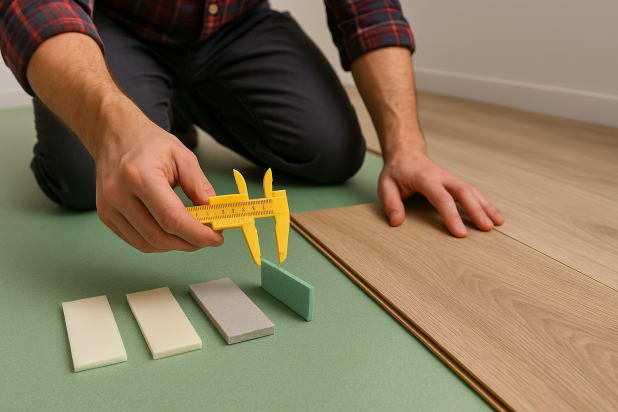
If your main goal is to even out a surface previously covered with tiles or another type of flooring, then a thickness between 2 mm and a maximum of 3 mm is justified.
Available options include underlays from 0.7 mm to 2 mm thick for SPC vinyl panels, as well as slightly thicker ones (2–3 mm) ideal for wood-based laminate panels.
However, the true quality of an underlay is best judged by its performance parameters, as defined in the EN 16354 standard. According to this standard, a good underlay should provide:
-
effective sound insulation,
-
high resistance to pressure and dynamic loads,
-
compensation of minor unevenness,
-
and low thermal resistance (important when using underfloor heating).
An underlay that meets all these criteria at a high level will ensure optimal performance, contribute to the durability of your panels, and improve daily comfort.
Choose the Ideal Underlay – Types and Specifications
Weninger offers several types of underlays for laminate flooring that meet the required standards and technical parameters to ensure floor functionality, durability, and strength.
For floating installation of laminate flooring and parquet, the PROFI PE underlay is a top choice. Made from high-density, permanently elastic polyethylene foam, it’s moisture-resistant and suitable for underfloor heating systems. It also offers thermal and sound insulation, which is essential for homes and apartments.
For LVT/SPC vinyl floors installed with a floating method, the AQUA PROFI LVT underlay is an excellent choice. It’s made of 93% natural, high-density mineral-polyurethane mass. Thanks to its low thermal resistance, it's ideal for water-based underfloor heating systems. It's considered one of the best products on the market and is resistant to pressure, moisture, and fire, while also providing excellent soundproofing.
For water-resistant laminate floors (up to 24 hours), we recommend the ALU AQUA 3 in 1 underlay. Made from high-density polyethylene, it includes an integrated aluminized vapor barrier foil and adhesive tape for joining strips. This 2 mm acoustic underlay is also suitable for water-based underfloor heating systems.
Important Note: Laminate panels must be installed over silver-colored foil. After laying the underlay, the aluminum foil must remain visible.